Information Dissemination:
• The CSA Newsletter
Now in its twenty-third year and with all issues available on the Web, The CSA Newsletter includes articles about projects, specific technologies, and technology trends of interest. (A limited subject index is available.
• Technology Information
The CSA Technology Information web page is a gateway to materials designed to aid archaeologists and architectural historians when considering computer technologies, especially CAD and database management systems.
•
Many documents were created for CSA's digital archiving efforts. Those archival efforts have all been discontinued, but the documents concerning archival needs and procedures remain valuable. They may be found via the archives page.
Projects:
• The CSA Propylaea Project.
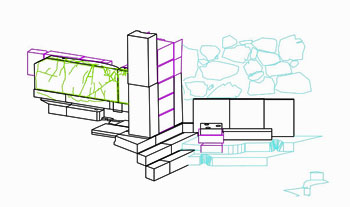
This was a cooperative project to create a single digital resource of information about the Propylaea. The project has been terminated, as has the website at propylaea.org. All materials produced may now be accessed through the Archaeology Data Service in York, England.
• The Older Propylon Project. This is a concluded research project of CSA Director Harrison Eiteljorg, II. The results of this project have been published; archival materials, including CAD models, may be accessed through the Archaeological Research Institute at Arizona State University.
• Lantern Slides of Classical Antiquity
This project was a joint CSA/Bryn Mawr College project. Lantern slides from the College collection were digitized and made available on the Web, and high-resolution images were archived for future use. This project is now maintained by Bryn Mawr College.
• Pompeii Forum Project CSA participates in this on-going project, Directed by Prof. John J. Dobbins (University of Virginia), to study the Forum of ancient Pompeii. A computer-aided design model is being constructed of the forum.
• Bryn Mawr Electronic Resources Review (BMERR). BMERR was an online journal for reviews of electronic resources concerning the ancient world. Bryn Mawr Classical Review (BMCR) is now publishing reviews of electronic resources, and BMERR has discontinued its separate existence. Reviews published 1998-2000 are now available through the BMCR web site (http://bmcr.brynmawr.edu/) and they are available via the BMERR page there.
•
Introduction
The use of advanced computer programs and information technnology in archaeology and architectural history -- whether to record information digitally as part of a project or to retrieve and re-use digital information already recorded -- requires some expertise. While that expertise can only be obtained with considerable time and experience using the computers and programs in question, information is provided here to help potential users know more about the computer programs likely to be encountered, the problems to be expected, the hardware required, and the like. The broadest and most recent of these resources is the book (in downloadable PDF form) authored by CSA Director Harrison Eiteljorg, II, and the Director of the Center for Advanced Spacial Technologies at the University of Arkansas, W. Fredrick Limp: Archaeological Computing.
The materials available through this page were prepared for the Web or for paper-based publication, and the CSA CAD Guide for Archaeologists and Architectural Historians was written in cooperation with the Archaeology Data Service. Unless otherwise noted, the materials available here were written by CSA Director Harrison Eiteljorg, II.
Readers' comments regarding any of these materials would be gratefully received. Just email your comments to CSA Director Harrison Eiteljorg, II, at user name: director at (@) domain name: csanet.org. You may also check the email contacts page.
CSA personnel will also assist with specific software preparation and training for archaeological or architectural history projects. To arrange for such assistance, please contact CSA Director Harrison Eiteljorg, II.
General resources:- Archaeological Computing. A book in downloadable PDF form covering a wide range of issues in archaeological computing from very basic ideas about how, when, where, and why to use computing technology; to hardware and operating systems; to the critical software tools for recording archaeological data; to archiving of the data.
- A basic, general introduction to databases.
- CSA's CAD booklet to introduce some basic information about CAD, Computer-Assisted Drafting And Design: New Technologies For Old Problems. This is somewhat dated by now, having been written in 1988 and updated last in 1996.
- CSA's surveying booklet to discuss some important ideas about surveying, Surveying for Computer-Aided Drafting and Design - Experiments in Three-dimensional Techniques. This is also somewhat dated at this time.
- CSA CAD Guide for Archaeologists and Architectural Historians. A longer, more comprehensive introduction to CAD for archaeology and architectural history, written more recently than the booklet mentioned above.
- A discussion of database design and organization issues. This document is also somewhat dated, especially in light of the existence of Archaeological Computing, with its lengthy treatment of databases.
- A complex database for a portion of the analyzed pottery from J. B. Rutter's The Pottery of Lerna IV, as adapted for a database by Susan C. Jones and Harrison Eiteljorg, II. Documentation of the database system developed for this project, and downloadable database files may be accessed through this page. While this is also somewhat dated, its base in specific data helps it remain useful.
- The CSA Layer-Naming Convention discusses ways to use CAD layers and layer names to aid in analysis of structures or archaeological sites.
- CSA AutoLISP routines for AutoCAD to automate some AutoCAD processes that are often used in modeling standing architecture and archaeological excavations.
- A tutorial for those wishing to learn to use AutoCAD; the tutorial was developed by CSA Director Harrison Eiteljorg, II, and Carleton College Professor Nancy Wilkie.
For more information about AutoCAD, see http://www.autodesk.com (the company site).
- Title: CSA Information Technology Page
- Author: Harrison Eiteljorg, II and the staff of CSA, Box 60, Bryn Mawr, PA 19010 (email: user-name nicke at (@) domain-name csanet.org; tel.: 484-612-5862)
- File name: inftech.html
- Revision history: This document was first posted in June, 2000. Regular revisions will occur, and past versions will not be archived. Last revision: August, 2010, a mostly cosmetic revision of the January, 2003, revision.
- Internet access: This document is maintained at csanet.org by the Center for the Study of Architecture and Harrison Eiteljorg, II. Note that there may be changes in computer addresses that are beyond the control of CSA.
- Long-term availability: This document or its successors will be maintained for electronic access indefinitely. Prior versions will not be archived.
- Citation permissions and copyright information: This document is copyrighted by CSA. Citations should include the date the document was accessed.